Home Improvement Franchises Compared: 24 FDDs on Revenue, Fees and Growth (2026)


Important note — please read before using this guide. The financial, fee and outlet figures in this article are drawn from the most recent Franchise Disclosure Documents (FDDs) available at the time of writing: 2026 registration-year filings reporting calendar 2025 for twenty of the twenty-four brands, and 2025 filings reporting calendar 2024 for ReBath, Bloomin' Blinds, Closet Factory and Ideal Siding. FDDs are re-filed every year, so newer numbers may exist by the time you read this. This guide is editorial research and industry commentary. It is not financial, legal, tax or investment advice and should not be treated as a recommendation to invest in any particular franchise. We cover only brands that make a Financial Performance Representation (FDD Item 19), because we favour transparency; home improvement franchisors that decline to disclose franchisee results are not featured here. Always pull the current FDD for any brand you are seriously considering, and work with a qualified franchise attorney and an independent financial advisor before signing anything.
Twenty-four home improvement franchisors publish revenue figures for their franchisees. Every one of them uses the word "median" or "average". They do not mean the same thing by it.
Thirteen of the twenty-four report per territory: one owner, one protected area, one number. Nine report per owner, adding up every territory that person controls before computing the statistic, and in this category owners routinely hold three, four or twelve territories. Two more report something else entirely: Five Star Painting discloses only what a job is worth, and Ideal Siding publishes seven income statements. So when Koala Insulation reports a median of $1,009,689 and Kitchen Tune-Up reports $361,644, the gap between them is mostly a difference in what got counted, not in how the businesses perform. Reading this page well means reading the yardstick before the number, and we have put the yardstick in its own column.
That column is the most important one on the page.
The other thing the filings show, plainly, is churn. Two of the fastest-growing systems of 2023 and 2024 shed territories in 2025 at a rate that should give any buyer pause, and one long-established refinishing brand has lost a third of its system in three years. Item 20 is often skipped in favour of Item 19. In home improvement it deserves equal time.
{{home-improvement}}
One row per brand, grouped by trade. "Upfront fees" is everything Item 5 says you pay the franchisor to get started for one territory: the franchise fee plus any mandatory territory fee, start-up fee, marketing-launch fee or technology set-up fee. Trucks, rigs and equipment packages are left inside the investment column where they belong, and the split is explained below the table. "Unit basis" is the yardstick: per territory, or per owner with all territories combined.
| Brand | What Item 19 reports | Upfront fees | Royalty + ad fund | Total investment | FPR? | Unit basis | Outlets |
|---|---|---|---|---|---|---|---|
| Kitchen Tune-Up Kitchen & bath · 2026 FDD | $361,644 median gross sales, 2025 (n=75 of 135) | $79,950 | 6% (5% above $83,300/mo) + 1% or $500/mo | $121,930 – $198,850 | Yes | Per territory | 250 (2025) |
| Miracle Method Kitchen & bath · 2026 FDD | $1,083,293 median gross revenues, 2025 (n=64 of 213) | $60,000 | 5.5% + 2% | $142,500 – $261,800 | Yes | Per owner (all territories) | 149 (2025) |
| ReBath Kitchen & bath · 2025 FDD | $2,548,254 median gross sales, 2024 (n=113 of 145) | $50,000 | 6% + 2% | $275,875 – $606,925 | Yes | Per territory | 145 (2024) |
| Kitchen Solvers Kitchen & bath · 2026 FDD | $614,665 median gross revenue, 2025 (n=18 of 58) | $67,000 | 6% sliding to 2% + 1% | $102,367 – $149,152 | Yes | Per owner (all territories) | 58 (2025) |
| Five Star Painting Painting · 2026 FDD | $3,696 median gross sales per job, 2025 (n=208 of 245) | $45,000 – $68,000 | 6% + 2% | $82,200 – $194,600 | Yes | Other | 245 (2025) |
| Fresh Coat Painting · 2026 FDD | $653,107 median gross revenue, 2025 (n=62 of 182) | $54,900 | 6% + 2% ($350/mo min) | $86,150 – $125,250 | Yes | Per territory | 182 (2025) |
| CertaPro Painters Painting · 2026 FDD | $1,294,333 median gross sales, 2025 (n=291 of 299) | $82,500 | 6% (5%/4% above $2.5M/$5M) + 3% (2% above $2.5M) | $171,000 – $320,500 | Yes | Per owner (all territories) | 304 (2025) |
| Mr. Handyman Handyman · 2026 FDD | $580,422 median gross sales, 2025 (n=57 of 165) | $72,500 | 7% + 2% | $161,900 – $215,000 | Yes | Per territory | 357 (2025) |
| Ace Handyman Services Handyman · 2026 FDD | Quartile averages $250,699 to $775,337 total revenue, 2025 (n=77 of 309) | $70,000 – $100,000 | 6% + 2% | $132,200 – $226,000 | Yes | Per territory | 401 (2025) |
| Handyman Connection Handyman · 2026 FDD | $448,600 median gross sales, 2025 (n=28 of 49) | $77,000 | 6% + 2% | $115,837 – $238,736 | Yes | Per territory | 65 (2025) |
| Budget Blinds Window treatments · 2026 FDD | $522,826 median gross sales, 2025 (n=282 of 612) | $49,950 – $89,950 | 3.5% (min $1,250–$2,500/mo) + $500–$1,000/mo flat | $100,500 – $211,250 | Yes | Per territory | 1,355 (2025) |
| Bloomin' Blinds Window treatments · 2025 FDD | $400,282 median total sales, 2024 (n=49 of 78) | $84,500 | 6% (min $600/mo) + 2% or $300/mo | $129,100 – $245,500 | Yes | Per owner (all territories) | 145 (2024) |
| Closets by Design Closets & garage · 2026 FDD | $5,698,104 median annual sales (contracts sold), 2025 (n=78 of 90) | $38,000 – $55,000 | 7.25% (min $3,000/mo) + 2.25% (rising to 2.75%) | $154,000 – $511,000 | Yes | Per territory | 90 (2025) |
| Closet Factory Closets & garage · 2025 FDD | $4,618,860 median gross sales, 2024 (n=47) | $58,500 | 6.75% (min $975/wk) + 15% total marketing floor | $392,500 – $663,500 | Yes | Per owner (all territories) | 92 (2024) |
| The Tailored Closet Closets & garage · 2026 FDD | $322,264 median gross sales, 2025 (n=40 of 66) | $74,950 | 5% (min $500–$1,000/mo) + 1% or $250/mo | $177,130 – $270,650 | Yes | Per territory | 136 (2025) |
| Garage Experts Closets & garage · 2026 FDD | $624,466 median gross sales, 2025 (n=46 of 58) | $39,500 – $55,900 | 6% (min $250–$1,500/mo) + 1.5% | $109,900 – $246,400 | Yes | Per territory | 110 (2025) |
| Footprints Floors Flooring & refinishing · 2026 FDD | $594,655 median gross sales, outlets open 3+ years, 2025 (n=55 of 79) | $69,930 | 6% (min $500–$1,500/mo) + 0.25% now, up to 2% | $81,905 – $118,330 | Yes | Per territory | 85 (2025) |
| N-Hance Flooring & refinishing · 2026 FDD | $400,837 median gross revenue, 2025 (n=67 of 86) | $22,500 – $39,000 | 6% (min $450–$900/mo) + 2% | $72,568 – $193,845 | Yes | Per owner (all territories) | 209 (2025) |
| Ideal Siding Exterior · 2025 FDD | $950,682 average sales, 2024 (n=8 of 44) | $60,000 | 8% + 1% | $73,500 – $111,800 | Yes | Other | 44 (2024) |
| Window World Exterior · 2026 FDD | $2,660,959 median gross sales, small-market tier, 2025 (n=71 of 208) | $45,000 | per-product royalty in vendor pricing; no ad fund | $123,200 – $362,500 | Yes | Per territory | 211 (2025) |
| Mighty Dog Roofing Exterior · 2026 FDD | $963,683 median gross sales, 2025 (n=70 of 74) | $80,000 | 6% tiered (min $500/mo) + not currently assessed (up to 3%) | $173,672 – $225,816 | Yes | Per owner (all territories) | 329 (2025) |
| Sam the Concrete Man Exterior · 2026 FDD | $940,276 median gross revenue, 2025 (n=36 of 111) | $53,921 – $71,421 | 6% (min $2,500–$3,055/mo in season) + 2% | $93,070 – $151,185 | Yes | Per territory | 113 (2025) |
| USA Insulation Insulation · 2026 FDD | $1,491,238 median gross sales, 2025 (n=37 of 47) | $45,000 – $55,000 | 5% (min $1,000/mo) + 2% (min $500/mo) | $304,400 – $476,750 | Yes | Per owner (all territories) | 97 (2025) |
| Koala Insulation Insulation · 2026 FDD | $1,009,689 median gross sales, FY to Sep 2025 (n=76) | $54,500 | 6.5% tiered to 3.5% (min $1,083–$1,219/mo) + 1% (up to 2%) | $194,885 – $241,736 | Yes | Per owner (all territories) | 333 (2025) |
Ace Handyman Services publishes eight full profit-and-loss tables but never prints an all-territory median, so its cell shows the range of quartile averages rather than a figure the FDD does not contain. Five Star Painting reports per job only. Ideal Siding's average rests on seven statements. Where a brand reports per owner, the table says so and the prose below gives the best per-territory reading the document allows. Several of these FDDs run to eight or ten performance tables; the figures here are the ones a buyer needs first, and the full tables are best reviewed in the original document once a shortlist exists.
Kitchen Tune-Up is the cleanest illustration because it prints both yardsticks side by side. Its 75 single-territory franchisees open all of 2025 had median gross sales of $361,644. Its 60 multi-territory franchisees had a median of $805,441, but those 60 owners operate 154 territories between them, about 2.6 each, and the figure is their combined sales. Divide it through and a territory inside a multi-territory group is doing roughly what a single territory does. The multi-territory number looks more than twice as large and describes almost exactly the same business.
Now apply that to a brand that only prints the second kind of number. Koala Insulation's 2026 FDD reports a median of $1,009,689 and an average of $1,290,342 across 76 franchisees. Sixty-nine of those 76 run between two and twelve territories, and together they operate 324 territories. The only per-territory figure in the document is the seven single-territory operators, whose median was $715,690. Mighty Dog Roofing's 70 reporting franchisees operate 277 territories, close to four each; its $963,683 median is a per-owner figure and the implied per-territory average is nearer $371,000. USA Insulation's $1,491,238 median covers 37 franchisees holding 74 territories. CertaPro's $1,294,333 covers 299 franchisees who own 425 territories. None of this is hidden. It is stated in each Item 19, usually in a footnote, and it changes the meaning of the headline by a factor of two or more.
There is a second reason to care, and Ace Handyman Services documents it better than anyone. Ace's single-territory operators in the top revenue quartile averaged $775,337 in 2025 and kept $49,793 as owner discretionary income, about 6%. The bottom quartile averaged $250,699 and kept $3,994. Multi-territory groups in the top two quartiles kept 15% to 19%. In a labour business with a fixed overhead of office, software and marketing, the second and third territories carry far less cost than the first. That is why the per-owner figures in this category are not simply inflated versions of per-territory figures; the owners reporting them are often running a structurally more profitable business. The catch is that you cannot buy that business on day one. You buy one territory.
Kitchen Tune-Up refaces and redoors cabinets rather than replacing them, and the economics look like it. A single territory carried a $361,644 median in 2025 against an average of $521,522, with a 75th percentile of $733,643. Cost of goods runs 42% of sales, split 15% labour and 28% product, which leaves a 58% gross margin before any overhead. The upfront cost is the thing to notice: the $19,950 franchise fee sits on top of a $60,000 initial territory fee, so the cheque to the franchisor is $79,950 before a van is bought, and the system has contracted from 274 territories at the end of 2023 to 250 at the end of 2025.
Kitchen Solvers is a smaller sibling of the same idea, 58 territories, and its 2026 FDD reports a $614,665 median per owner across 18 compliant owners who run 32 territories. The franchisor also prints a separate table for owners who did not comply with its reporting standards, and that group averaged $262,544. Buyers should read both tables. Material costs average 42.6% of revenue and installation another 20.4%.
ReBath is a full bathroom remodeller and the numbers are of a different order. Its 2025 FDD reports 2024 median gross sales of $2,548,254 per territory across 113 of 145 territories, an average of $3,904,233 pulled up by a single $26.6 million territory, and, unusually, a net income line: 9.8% of sales on average, 8.6% at the median, with a range from a 59% loss to an 88% profit that says something about how consistently expenses were reported. Territories are large, 750,000 to 1.25 million people, and the investment runs $275,875 to $606,925. ReBath franchisees also spent an average of $398,326 on marketing in 2024 at a cost per lead of $162. This is a showroom-and-crew business, not a van.
Miracle Method refinishes tubs, tile and countertops in place. Its $1,083,293 median is per ownership group, and the groups in its top quartile operate five to nine territories each; the 26 single-outlet groups in its quartile table range from $158,769 to $2,764,179, which is the honest spread for one territory. Royalty is 5.5%, the lowest of the four, and a $10,000 initial marketing program fee is due within 60 days of signing on top of the $50,000 franchise fee.
CertaPro Painters prints every one of its 291 full-year franchisees' 2025 gross sales figures in a sorted list, which is the most transparent disclosure on this page. The median is $1,294,333, the average $2,102,015, and only 32% of franchisees reach that average. Between the $75,389 at the bottom of the list and the $15,731,772 at the top sits every kind of painting business a buyer might become. Year over year, the median slipped from $1,380,416, and the count of full-year franchisees fell from 311 in 2023.
CertaPro is also one of the few painters to publish margins, from a voluntary group of 74 larger, longer-tenured operators: median revenue $2,053,934, median gross profit 47%, and median EBITDA plus owner compensation of $142,921, or 7% of sales. Take that subset for what it is. It skews commercial and established. The system requires 12% of gross sales in total advertising in year one and 10% after, of which 3% is the national fund, and its minimum royalty schedule climbs to $51,000 a year by year seven.
Fresh Coat reports per territory and the sample is narrow: 62 of 182 franchises qualified for 2025, a third of the system, by being open a full year, operating full time and filing income statements by the end of March. Their median gross revenue was $653,107, the average $751,964, and 27% reached that average. Gross profit, defined as revenue less direct labour and paint, averaged 37.8% in 2025, down from 43.8% the year before. Fresh Coat requires the greater of 10% of revenue or $3,000 a month in local marketing for the first three years. Its system fell from 187 to 182 territories in 2025, with 28 exits against 23 openings, and seven of the exits were territories the franchisor took back.
Five Star Painting, a Neighborly brand with 245 territories, discloses no annual revenue at all. Its Item 19 gives two ratios: gross sales per head of territory population, with a $2.00 median, and gross sales per job, with a $3,696.30 median and a $4,439.87 average. The quartile spread on the per-capita measure runs from $5.10 down to 35 cents, a fifteen-fold gap. A buyer can multiply the median by a territory population and reach a figure around $350,000 for a 175,000-person territory, but that is arithmetic we are doing, not a number the franchisor stands behind, and the document should not be read as if it were. The fee stack here includes a mandatory call-centre service at $349.99 to $449.99 a month plus $15 per booked appointment, paid to an affiliate, and a required local marketing spend of $60,000 in year one and $75,000 in year two.
Mr. Handyman, also a Neighborly brand, reports by number of units owned. Its 57 single-unit franchisees had a 2025 median of $580,422 and an average of $773,574, lifted by one operator at $5.36 million. Two-unit owners had a median of $972,424 combined. The average job is small, $742 with a $721 median, so a single territory is doing roughly 800 jobs a year. The system grew from 308 to 357 territories over three years, the strongest net growth among the handyman brands, though terminations doubled to eleven in 2025. Royalty is 7%, the highest of the three, and local marketing minimums are $60,000 in year one, $75,000 in year two and 8% of prior-year sales after that.
Ace Handyman Services does not print a system median and we have not invented one. What it prints is better: full income statements by quartile for 309 of its 383 franchised territories, which is 81% of the system. Single-territory quartile averages run $775,337, $533,854, $347,542 and $250,699, so a median territory sits somewhere in the low-to-mid $400,000s. Owner discretionary income for single territories is thin in every quartile: $49,793, $40,188, $39,489 and $3,994. The top quartile carries $168,965 of average general and administrative cost, which is where the margin goes. Ace charges $599 a month for software and a minimum individual marketing spend that rises from $30,000 to $50,000 a year, and its company-owned count grew from 7 to 18 through reacquisitions from franchisees.
Handyman Connection is the smallest of the three at 65 territories, 49 of them in the United States, and the only one whose per-territory median has fallen two years running: $511,572 in 2023, $502,945 in 2024, $448,600 in 2025. The reporting base shrank from 31 franchisees to 27 over the same period, and the FDD itself notes that excluding two top performers who were resold lowered the 2025 average. Gross margin on service revenue averaged 50.4% across 25 statements. The upfront cost is $71,000 plus a $6,000 software licence, and the royalty base includes materials passed through to customers.
Budget Blinds is the largest system on this page at 1,355 territories, and it reports on 612 franchisees, 82% of those open all of 2025. Single-territory franchisees had a $522,826 median, an average of $774,915 pulled up by a $9.3 million outlier, and a 25th-to-75th percentile band of $340,525 to $921,140. Every single-territory statistic fell from 2024. So did the system: 2025 was Budget Blinds' first net decline, with 16 openings against 27 exits, and new openings have dropped from 78 to 35 to 16 over three years while transfers of existing territories rose from 69 to 97. The fee structure is unusual, a 3.5% royalty with a tiered monthly minimum of $1,250 to $2,500 and a flat national advertising payment of $500 to $1,000 a month, and the upfront cost pairs a $19,950 franchise fee with a territory fee of $30,000 to $70,000 depending on household count.
Bloomin' Blinds is a mobile alternative with 141 franchised territories at the end of 2024. Its 49 full-year franchisees, who between them ran 83 territories, had a median of $400,282 in 2024 total sales. It goes further than most on costs: gross profit averaged 46.7% and adjusted earnings, before owner pay, interest, taxes and depreciation, averaged $123,064 or 20.5% of sales across 43 reporting franchisees. One-van operators had a $345,780 median. The $49,500 franchise fee comes with a mandatory $35,000 start-up fee for inventory, tools and a vehicle wrap, and a shortfall royalty applies if sales fall below $80,000, $120,000 and $150,000 in years one to three.
The two closet brands report the largest numbers on this page, and both need a footnote. Closets by Design's 78 mature territories had 2025 median annual sales of $5,698,104, but "annual sales" means contracts signed, not work installed and invoiced, and one territory at $36.4 million lifts the average to $7.8 million. The supporting detail is useful: a closing ratio around 52% and an average contract just under $6,000. The upfront cost is a $20,000 franchise fee plus a territory fee of $18,000 to $35,000, and in developed markets a negotiated market development fee that ran from $15,380 to $270,000 in 2025. Royalty is 7.25% with a $3,000 monthly minimum whatever your revenue.
Closet Factory reports per business, and a business can be up to five territories; its 47 franchised businesses held 86 territories at the end of 2024. The 2024 median was $4,618,860, the average $6,097,058 with a $39.1 million business at the top, and the bottom quartile averaged $1,244,968 with a low of $350,963. Investment runs $392,500 to $663,500, a showroom-and-manufacturing footprint, and the franchisor requires a minimum of 15% of gross receipts in marketing spend. Its sales-per-appointment figures, $3,575 to $4,946 by quartile, are a good sanity check on any pro forma.
The Tailored Closet and Garage Experts are the van-based end of this segment. The Tailored Closet's 40 single-territory franchisees had a $322,264 median in 2025, an average of $506,934, and a range from $14,875 to $2.3 million; the system has shrunk from 169 to 136 territories in three years, with 17 territories ceasing operations in 2024 alone. Its $19,950 franchise fee, like its sister brands Budget Blinds and Kitchen Tune-Up, comes with a mandatory $55,000 territory fee. Garage Experts, a floor-coating and storage concept, had a $624,466 median across 46 single-territory owners with a $686,909 average and a range of $160,409 to $1,538,069, and it discloses gross profit after labour and materials of $330,195 on average. Its 21 multi-territory owners averaged $1,234,654 combined. The system moved from 104 to 110 territories.
Footprints Floors runs a subcontractor model with no showroom, which is why its investment is the lowest here after Ideal Siding, $81,905 to $118,330. The 2026 FDD reports on 79 of 96 outlets, sliced by age and by half: outlets open more than three years had a $594,655 median, the top half of all outlets a $771,390 median and the bottom half $338,018, and outlets in their first or second year a $257,142 median. Direct gross margin, after flooring, field labour and subcontractors, averages about 46%. The mandatory contact centre takes 2.5% of sales. The company-owned outlet in Colorado, which spans five territories, did $3.66 million.
N-Hance, a wood refinishing brand, is the cautionary Item 20 on this page. Its 2025 median of $400,837 is per owner, and 67 active owners operate 180 businesses, so the implied figure per business is about $233,000. The system has gone from 317 franchised businesses at the start of 2023 to 209 at the end of 2025: 15 openings against 122 exits, including 66 terminations and 47 non-renewals. Florida fell from 45 to 24 in two years. The licence fee is $22,500 for a small market or $39,000 for a traditional one, but a mandatory equipment package of $41,495 to $49,000 is bundled into the FDD's printed initial fee, and every business must buy at least $4,430 of proprietary product a year.
Window World is the largest business a home improvement franchisee can buy on this page, and its FDD is built for benchmarking: it covers 208 of the 211 outlets in the system for 2025, segmented by market size. Median gross sales were $2,660,959 in small markets of 150,000 owner-occupied homes or fewer, $4,736,585 in medium, $5,278,521 in large and $6,883,615 in metro markets, where one franchise did $42.4 million. The franchise fee is a flat $45,000 and there is no percentage royalty and no national advertising fund; the franchisor earns a per-product royalty inside the price of every window and door you buy from its approved vendors, currently 10 cents to $75 per unit or up to 12% of product cost. That makes Window World's continuing fees impossible to state as a percentage of sales, and a buyer should model them from product mix. The system has been flat at 211 for three years.
Sam the Concrete Man is the standout disclosure among the smaller exterior brands. Its 36 full-year franchisees had a 2025 median gross revenue of $940,276 and an average of $998,115, and the FDD carries a full profit-and-loss statement to discretionary earnings: $201,707 on average, 20% of revenue, and $166,338 at the median. Gross profit averages 33%, which is what a poured-concrete business looks like. The sample is 36 of 111 franchised territories, with 26 excluded for unreliable reporting, and the system's growth, 66 to 113 outlets in three years, came with 56 terminations against 105 openings. A call-centre and support fee of $1,474 a month applies from March to November.
Mighty Dog Roofing grew from 235 to 403 territories in two years and then lost 74 of them in 2025, all recorded as terminations, 29 of them in Texas. Its per-owner median of $963,683 spreads across roughly four territories per owner, and the bottom quartile of owners averaged $303,699 with a low of $34,670. The average roofing job is $11,145. Upfront fees are $80,000: a $59,500 franchise fee, a $15,500 brand marketing fee and a $5,000 partnership fee.
Ideal Siding is at the opposite end of the life cycle, 44 territories at the end of 2024 having opened 27 that year. Its Item 19 covers seven income statements from the eight outlets old enough to qualify, averaging $950,682 in sales with owner discretionary profit of $232,033, or 24%, and an average project of $18,633. Read it as a description of the earliest cohort rather than a system, and note that the 8% royalty carries a lead fee of the greater of $2,000 a month or 5% of sales on top.
USA Insulation and Koala Insulation both report per franchisee, both had strong-looking medians and both had a bad 2025. USA Insulation's 37 full-year franchisees, holding 74 territories, had a $1,491,238 median and a $1,588,037 average; the implied per-territory figure is under $800,000. During 2025 the system terminated 21 territories and 13 franchises closed permanently, taking the count from 110 to 97, and 8 more franchises did not report, so the Item 19 sample is the survivors. Investment is the highest of the mobile brands at $304,400 to $476,750 because it includes a $59,000 to $72,000 truck up-fit and initial inventory bought from an affiliate, and franchisees must keep buying proprietary foam. Local advertising is set at 15% of the prior month's sales.
Koala Insulation's numbers were covered above: a $1,009,689 median per franchisee across 324 territories, and a $715,690 median for its seven single-territory operators. It adds a benchmarking study of 56 franchisees open two years or more, with 2024 gross profit of 48.6% and revenue less cost of goods and certain expenses of $211,897, or 16.7%, before owner compensation. Item 20 shows 392 territories at the start of 2025 and 333 at the end, with 85 terminations and zero of any other kind of exit; Texas alone dropped from 50 to 35. The royalty is 6.5% on the first million of sales, stepping down to 3.5%, with a monthly minimum from month seven and a mandatory bookkeeping vendor at $350 a month in year one.
One way to put the per-territory brands on a common footing is to divide the median revenue each one discloses by the midpoint of its own Item 7 investment range. It is a crude ratio, revenue is not profit and a low-investment subcontractor model will always score higher than a showroom, but it separates the brands where the revenue is large because the business is large from the brands where the revenue is large relative to what you put in. Only brands that report per territory are included, so that like is compared with like; Closets by Design is left out because its figure counts contracts signed rather than revenue, and Ace Handyman Services because it prints no median.
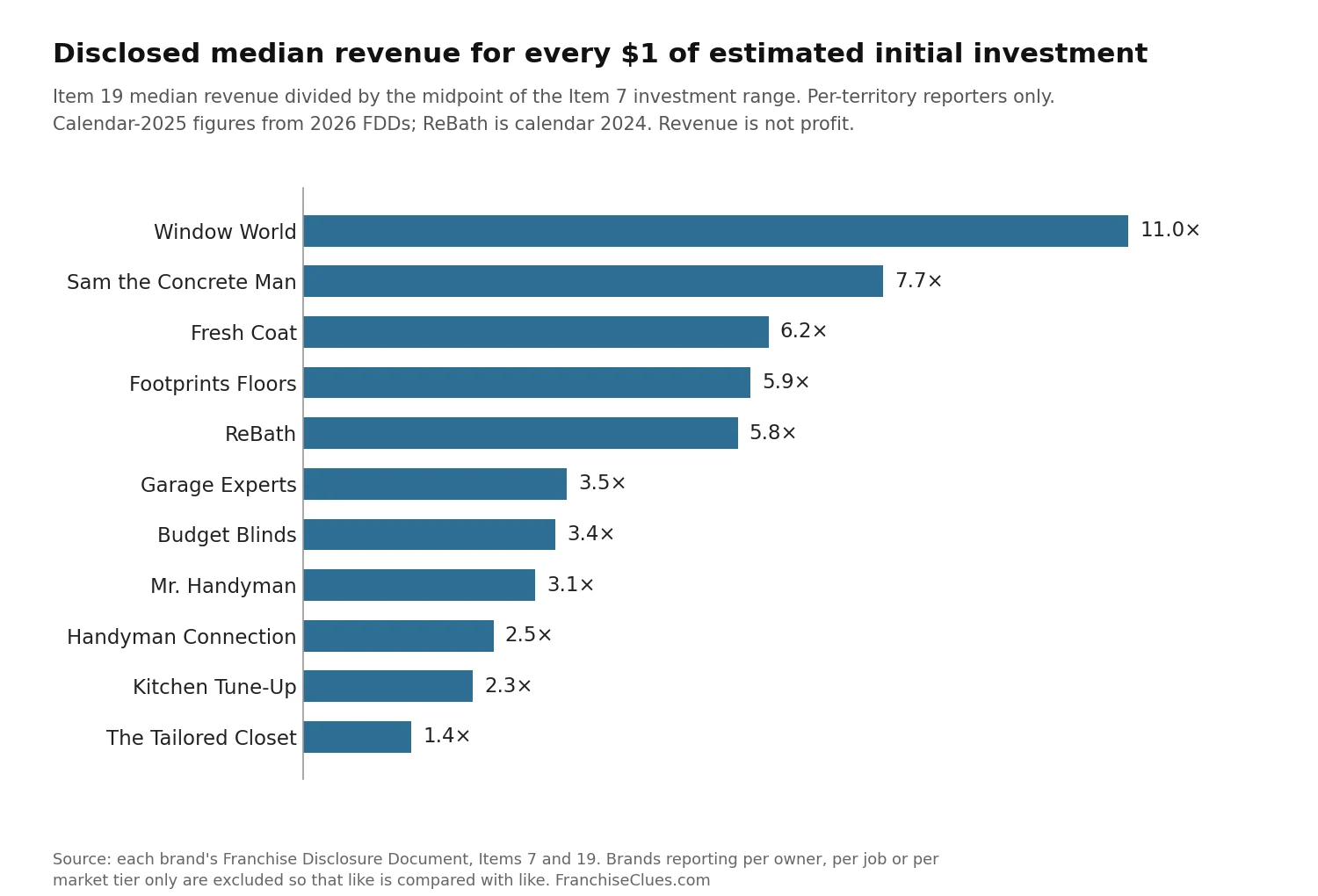
| Brand | Median revenue (Item 19) | Investment range (Item 7) | Revenue per $1 invested |
|---|---|---|---|
| Window World | $2,660,959 | $123,200 – $362,500 | 11.0× |
| Sam the Concrete Man | $940,276 | $93,070 – $151,185 | 7.7× |
| Fresh Coat | $653,107 | $86,150 – $125,250 | 6.2× |
| Footprints Floors | $594,655 | $81,905 – $118,330 | 5.9× |
| ReBath | $2,548,254 | $275,875 – $606,925 | 5.8× |
| Garage Experts | $624,466 | $109,900 – $246,400 | 3.5× |
| Budget Blinds | $522,826 | $100,500 – $211,250 | 3.4× |
| Mr. Handyman | $580,422 | $161,900 – $215,000 | 3.1× |
| Handyman Connection | $448,600 | $115,837 – $238,736 | 2.5× |
| Kitchen Tune-Up | $361,644 | $121,930 – $198,850 | 2.3× |
| The Tailored Closet | $322,264 | $177,130 – $270,650 | 1.4× |
The subcontractor and mobile models, Fresh Coat, Footprints Floors and Sam the Concrete Man, turn a $100,000 to $125,000 investment into $600,000 to $940,000 of median revenue, and ReBath does nearly as well at five times the scale. The two brands at the bottom, Kitchen Tune-Up and The Tailored Closet, are the ones whose $55,000 to $60,000 territory fees inflate the investment without adding to the business, and whose systems are shrinking.
The ratio is not a verdict on either brand. It is a prompt to ask what the territory fee is buying.
The franchise fee is rarely the whole cost of getting in, and in this category the gap is wider than usual. Three brands owned by Home Franchise Concepts, Budget Blinds, Kitchen Tune-Up and The Tailored Closet, print a $19,950 franchise fee and then a mandatory initial territory fee of $30,000 to $70,000. Bloomin' Blinds adds a $35,000 start-up fee. Mighty Dog adds $20,500 in marketing and partnership fees. CertaPro adds $17,500 in set-up and commercial-services fees. Closets by Design adds a territory fee and, in most established markets, a negotiated market development fee that reached $270,000 in 2025. We have folded all of these into the table's upfront column so that the brands can be compared on what a buyer actually pays the franchisor.
Equipment packages are a different matter and sit in the investment column: USA Insulation's truck, Koala's rigs, N-Hance's $41,495 to $49,000 package and Garage Experts' $23,500 of coating materials.
The continuing fees deserve the same treatment. A 6% royalty is the norm, but many of these brands attach a minimum that applies regardless of sales: $3,000 a month at Closets by Design, $2,500 to $3,055 a month in season at Sam the Concrete Man, $1,250 to $2,500 at Budget Blinds, $975 a week at Closet Factory after week 40, and an annual schedule at CertaPro that reaches $51,000. Mandatory call centres are a second layer: 2.5% of sales at Footprints Floors, $350 to $450 a month plus a per-appointment charge at the two Neighborly brands, $1,474 a month in season at Sam.
The local marketing floors are the largest line most first-year franchisees underestimate: $60,000 in year one at Five Star Painting and Mr. Handyman, $50,000 at Garage Experts, $30,000 rising to $50,000 at Ace, 15% of receipts at Closet Factory and USA Insulation, 12% at CertaPro, 10% at Fresh Coat and Handyman Connection. Item 6 lists all of these.
Add them up before you add up the revenue.
Item 20 records how many outlets a system had at the start and end of each of the last three years, and why the ones that left did so. The table ranks the twenty-four brands by net change over that period. It is worth reading alongside the openings and exits in each FDD, because a flat total can hide a lot of turnover, and a large positive can be two years of selling followed by a year of terminations.
| Brand | Outlets, start of period to end | Three-year net change |
|---|---|---|
| Mighty Dog Roofing | 235 → 329 (2023–2025) | +94 |
| Ace Handyman Services | 312 → 401 (2023–2025) | +89 |
| Bloomin' Blinds | 70 → 145 (2022–2024) | +75 |
| Budget Blinds | 1,298 → 1,355 (2023–2025) | +57 |
| Mr. Handyman | 308 → 357 (2023–2025) | +49 |
| Sam the Concrete Man | 66 → 113 (2023–2025) | +47 |
| Ideal Siding | 0 → 44 (2022–2024) | +44 |
| ReBath | 110 → 145 (2022–2024) | +35 |
| Miracle Method | 122 → 149 (2023–2025) | +27 |
| Closets by Design | 72 → 90 (2023–2025) | +18 |
| Closet Factory | 75 → 92 (2022–2024) | +17 |
| Fresh Coat | 166 → 182 (2023–2025) | +16 |
| Five Star Painting | 230 → 245 (2023–2025) | +15 |
| Kitchen Solvers | 51 → 58 (2023–2025) | +7 |
| Handyman Connection | 58 → 65 (2023–2025) | +7 |
| Footprints Floors | 78 → 85 (2023–2025) | +7 |
| Koala Insulation | 326 → 333 (2023–2025) | +7 |
| USA Insulation | 92 → 97 (2023–2025) | +5 |
| Garage Experts | 106 → 110 (2023–2025) | +4 |
| Window World | 211 → 211 (2023–2025) | +0 |
| Kitchen Tune-Up | 257 → 250 (2023–2025) | -7 |
| CertaPro Painters | 331 → 304 (2023–2025) | -27 |
| The Tailored Closet | 169 → 136 (2023–2025) | -33 |
| N-Hance | 317 → 209 (2023–2025) | -108 |
Ace Handyman Services, Mighty Dog Roofing, Bloomin' Blinds and Budget Blinds have the largest three-year gains, and three of the four carry a caveat. Mighty Dog's +94 is 222 openings in 2023 and 2024 followed by 100 terminations in 2025. Budget Blinds' +57 was earned in 2023 and the system has since gone into decline. Bloomin' Blinds' figure ends in 2024 and its 2025 filing should be read before relying on it. Ace's growth is steadier, 40 openings against 26 exits in 2025, though 18 of its outlets are now company-owned after reacquisitions from franchisees. Sam the Concrete Man and Mr. Handyman added territories in all three years. Ideal Siding went from zero to 44.
At the other end, N-Hance lost 108 businesses, The Tailored Closet lost 33 and CertaPro lost 27 franchisees, though CertaPro's franchisees own 425 territories and the decline is in owners rather than coverage. Koala Insulation's +7 hides 141 openings and 134 terminations in three years, with 85 of the terminations in 2025. Kitchen Tune-Up drifted down 7. Window World did not move.
Which type of business you are buying matters more than which brand. A showroom remodeller such as ReBath, Closet Factory or Window World is a business with staff, a lease, install crews and marketing spend in the hundreds of thousands; the revenue is large and the investment is large, and the FDDs that report profit put it around 9% to 10% of sales. A van or subcontractor model such as Fresh Coat, Footprints Floors, Garage Experts or a handyman brand costs $80,000 to $250,000 to open, produces $300,000 to $700,000 in a typical single territory, and, on the evidence of Ace's and Bloomin' Blinds' cost data, leaves the owner somewhere between a modest salary and a comfortable one until a second territory is added.
Then find the yardstick in the table and hold every number to it. Where a brand reports per owner, ask the franchisor for the single-territory figures in the validation calls, and ask existing franchisees how many territories they run. Where it reports quartiles, look at the bottom one, because that is where a first-year operator starts. And where Item 20 shows terminations running ahead of openings, ask why, and ask the franchisees who left. The disclosures on this page are unusually detailed for a home-services category. The work is in reading them on their own terms.
Item 19 / Financial Performance Representation (FPR). The section of a Franchise Disclosure Document where a franchisor may, but is not required to, publish data on what its outlets earn. Franchisors that publish nothing here are not covered on this page.
Unit basis. Whether an Item 19 figure describes one territory or one owner with all of that owner's territories combined. The two are not comparable, and the difference is stated in each FDD's Item 19 notes.
Item 5 / upfront fees. Everything paid to the franchisor before opening: the franchise fee plus any territory fee, start-up fee, marketing-launch fee or set-up fee the FDD requires.
Item 6 / royalty and ad fund. The continuing fees paid to the franchisor, usually a percentage of gross sales, often with a fixed monthly minimum, plus a brand or national advertising fund contribution.
Item 7 / total investment. The franchisor's estimate of everything you will spend to open and run the business for its first few months, from the franchise fee to vehicles, equipment and working capital.
Item 20. The section reporting outlet counts: how many franchised and company-owned units opened, closed, transferred or were reacquired in each of the last three years, and why.
Owner discretionary income / discretionary earnings. Profit before the owner's own pay, interest, taxes and depreciation. It is what the business generates for the person running it, not a salary.
Median and average. The median is the middle outlet; half did better and half did worse. The average is the total divided by the count and is pulled upward by a few large outlets, which is why most averages on this page sit well above their medians.
How much does a home improvement franchise cost?
Total estimated investment runs from $73,500 for an Ideal Siding territory to $663,500 for a Closet Factory showroom, with most van-based and subcontractor brands between $80,000 and $250,000. Upfront fees paid to the franchisor range from $22,500 for an N-Hance small-market licence to $100,000 for the largest Ace Handyman territory, and several brands add a mandatory territory fee of $30,000 to $70,000 on top of a $19,950 franchise fee.
How much do home improvement franchise owners make?
It depends on the trade and on how the franchisor counts. Among brands reporting per territory, 2025 medians ran from $322,264 at The Tailored Closet and $361,644 at Kitchen Tune-Up to $940,276 at Sam the Concrete Man and $2,660,959 at a small-market Window World franchise. Brands that report per owner, such as Koala Insulation at $1,009,689 and CertaPro at $1,294,333, combine several territories into one figure. Only a handful disclose profit: Sam the Concrete Man reported median discretionary earnings of $166,338, Ace Handyman single-territory owners kept $3,994 to $49,793 on average by quartile, and ReBath reported average net income of 9.8% of sales.
Is a home improvement franchise profitable?
The FDDs that disclose costs show margins that depend heavily on scale. Ace Handyman's single-territory operators averaged 2% to 11% owner discretionary income by quartile while multi-territory groups averaged 8% to 19%. Sam the Concrete Man's franchisees averaged 20% discretionary earnings, Bloomin' Blinds' 20.5% adjusted earnings, Ideal Siding's first cohort 24% owner discretionary profit, and ReBath 9.8% net income after taxes. Most brands on this page disclose revenue only.
What does royalty mean for a home improvement franchise, and what other fees apply?
Royalty is the continuing fee paid to the franchisor, typically 5% to 7.25% of gross sales here, and many brands attach a fixed monthly minimum that applies whatever you sell. Window World charges no percentage royalty; it earns a per-product royalty inside vendor pricing. Beyond royalty, expect a brand fund of 1% to 3%, technology fees of $250 to $700 a month, mandatory call-centre fees at several brands, and local marketing floors that run from $30,000 to $75,000 a year or 10% to 15% of sales.
Why do some brands report revenue per owner instead of per territory?
Because their franchisees often own several territories and report combined books. Koala Insulation notes that 69 of its 76 reporting franchisees run two to twelve territories; Mighty Dog Roofing's 70 reporting franchisees operate 277. The resulting medians describe a multi-territory business, not the single territory a new buyer purchases. Kitchen Tune-Up, Budget Blinds and The Tailored Closet print both views, and the single-territory figure is roughly half the multi-territory one.
Which home improvement franchises are growing?
By three-year net change in Item 20, Ace Handyman Services added 89 outlets, Mighty Dog Roofing 94, Budget Blinds 57, Mr. Handyman 49, Sam the Concrete Man 47 and Ideal Siding 44. Several of those gains include heavy 2025 attrition: Mighty Dog terminated 100 territories in 2025, Koala Insulation 85 and USA Insulation 21, and Budget Blinds posted its first net decline. N-Hance lost 108 businesses over three years and The Tailored Closet 33.
Why are some well-known home improvement brands missing from this guide?
We only feature brands that publish an Item 19 Financial Performance Representation. SERVPRO, which appears on many home improvement lists, states in its FDD that it does not make one. DreamMaker Bath & Kitchen, California Closets, Concrete Craft, Solar Grids, Buddy's Home Furnishings and Vital Restoration were not in the filing set used for this analysis, and plumbing, appliance repair, pest control and restoration brands are covered on their own pages.
Twenty-four franchisors in this category told their prospective franchisees what the system earns, and most of them did it in more detail than the average home-services FDD. The figures are real and they are worth having. They are also easy to misread, because the largest ones describe owners rather than territories and the healthiest-looking growth curves include a year of terminations. The key questions to ask before signing are the ones this page has tried to answer for each brand: what is the yardstick, what does a first-year single territory look like, what fees sit under the franchise fee, and what happened to the franchisees who left. Request the current FDD, read Items 5, 6, 7, 19 and 20 in that order, and put the numbers to franchisees before you put your name on a franchise agreement.

Javier is an experienced franchise industry professional with a focus on development, operations, and performance. With almost a decade of experience in the industry, he has witnessed both the successes and failures of franchise owners. Javier strongly believes that buying a franchise is not just an investment, but a life-changing event that presents a unique opportunity for personal and professional growth. He enjoys helping aspiring franchise owners navigate the decision-making process and increase their chances of success.






















.svg)
.svg)


